Hmong Families Learn How to Eat Healthy

Sunday, May 1, 2011

Hmong families in northcentral Wisconsin are learning to eat healthier as part of Marathon County's Hmong Heritage Month.

A dietitian educated families at the Boys and Girls Club in Wausau on Saturday on what foods Hmong families should be cooking with.

An emphasis was placed on rice, because the majority of families eat white rice for two or three meals a day.

"We're going to try recipes that contain whole grain products such as brown rice, 100% whole wheat bread and see if they will like it and see if they will try that with their family," Mao Moua Vue, a dietitian said.

Fruits and vegetables were also highlighted as important foods for their diet.

The recipes they made were french toast with sweet potatoes and carrots, oatmeal and a Hmong salad that included a variety of vegetables.

Source

Read more...

Paj Ntaub - upcoming modern Hmong movie

Friday, April 29, 2011

stars Hmong Georgia folks. Props!!! Cannot wait.

For those who don't know Hmong, there is English subs :D

The video won't let me embed but watch it

http://www.youtube.com/watch?v=KAxcs36p4Vg

Synopsis:
A love triangle between two good friends Nraug Hli Xiong aka 'X', Tou Lee and a fictional dream girl, Nkauj Hnub Xiong. X is every woman's dream man. He's successful, intelligent and beyond gorgeous, but even with all his good fortune X is empty knowing and sensing that his life is hollow and missing an essential element. Searching for the spark to his life X turns to his dreams and there finds this fantasy girl. Their love blossoms in his subconscious and X deters from reality to find a way to make his fantasy love come to life. However, trying to change the hands of fate, changes their destiny and X is trapped between two worlds.

Read more...

Vietnam: Between tradition and modernity

Tuesday, April 26, 2011


Words by Nick Ahlmark, photographs by Nicole Precel

Back in the mid-1990s I was on a gap year before university and had somehow ended up in mid-West America. Wandering through a neighbourhood in La Crosse, Wisconsin, I saw groups of women in brightly-coloured dresses tending to corn crops in their front gardens and washing their clothes in large buckets on their porches.

In one of America's whitest states, this Asian community stood out. I turned to my American friend and asked who these people were? "Oh, they're the Hmong," he replied.

Further questioning revealed that the Hmong are a race of four million people spread out across southern China, Vietnam, Laos, Thailand, Cambodia and Burma. The Hmong of La Crosse are part of the about 180,000 strong refugee community in the US. The Hmong had fought for the Americans against the communists in Vietnam and Laos during the 1960s and 1970s and thus the US had taken in a significant number of Hmong asylum seekers after the Vietnam War.

What struck me on that sunny day in Wisconsin was how this community were dutifully sticking to their traditions. They were even stashing their garden crops in hand woven baskets, all this despite having been in one of the most modern countries on the planet for the best part of 20 years.

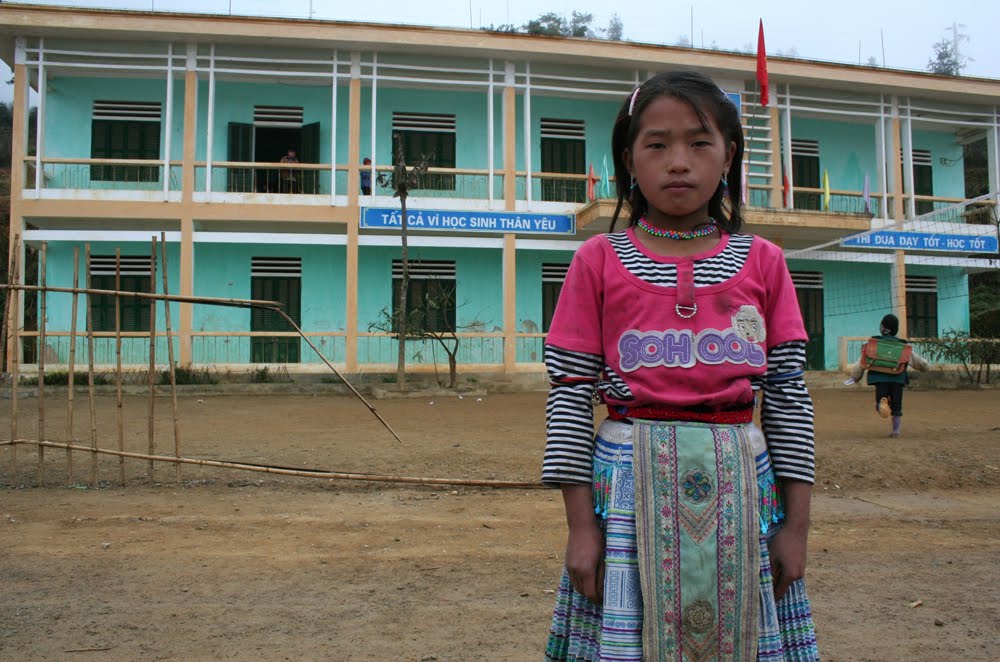
Fast forward to February 2011; myself and fellow filmmaker Nicole Precel find ourselves in Chi Ca Commune, a cluster of villages in Xin Man district, part of Ha Giang province in northern Vietnam, the poorest province in the country. We are here to make a film which will become the eighth and final episode of Al Jazeera's Birthrights, a series examining maternal health around the world.

It is the culmination of four months of researching and organising that ultimately enabled us to spend a full eight days in this politically sensitive area of Vietnam that borders China. We were told that this is more time than any other foreign journalist has been allowed in the region post the Vietnam War.

The environment is about as radically different from suburban Wisconsin as one can imagine, but even here, the clash of modernity and tradition is evident. Renowned for its mountains and stunning beauty, the population of Ha Giang province is 90 per cent ethnic minority of which the Hmong make up the second largest group.

Here, in the isolated Chi Ca commune, very few Hmong women choose to use the government-run health services to give birth or seek maternal care. The reasons are numerous and complex, but the first is language. In general, the Hmong do not speak Vietnamese and the Vietnamese do not speak Hmong. As all health workers are from the dominant Vietnamese Kinh ethnic group, this has proved to be a major obstacle.

The second is tradition. The Hmong believe in Shamanism and have a specific set of rituals surrounding all aspects of life and this includes childbirth. It is believed that after the birth, the placenta must be buried in a hole beneath the parents' bed. The babies' bath water must be poured into the hole for one month at which point it is covered up permanently. This tradition ensures the good health of the baby and when the child grows old and dies it must return to collect the placenta for a successful journey to the afterlife. If women give birth at the hospital, conducting this ritual becomes impossible for the Hmong.

The third reason is a lack of trust between the communist institutions and the Hmong. Academics have argued that the Hmong simply pay lip service to Vietnamese nationalism and the communist way. Inside every Hmong mud brick house, a picture of Ho Chi Minh and the communist party flag hangs on the wall. But we very much got the sense that the Hmong would prefer to be seen to conform so as not to cause trouble. That way they can go about their traditional lives but at the same time appease the communist authorities by playing their expected roles without great conviction but with enough diligence.

The fourth reason is distance. The villages of Chi Ca commune are spread out over many kilometres of mountainous terrain. For some pregnant women, getting to the local health centre requires an exhausting trek of up to 10 kilometres. The district hospital is between two and three hours by motorbike, depending on the state of the roads. These journeys are obviously incredibly risky for a heavily pregnant women who is about to give birth.

Vietnam is booming and with the boom has come a massive improvement in health care. Over the last 20 years maternal and infant mortality rates in the urban and low lying regions have improved greatly. But in Ha Giang province the maternal mortality rate is almost 10 times higher than in the more urbanised parts of the country. There are no statistics for Xin Man, but as the poorest district in Ha Giang one can only imagine that the figures are even worse.

Enter the United Nations Population Fund (UNFPA). Realising that cultural barriers are the main obstacles for ethnic minority women seeking professional health care, they have initiated a brilliant and highly successful scheme with the Ha Giang health authority. Targeting the most able and confident young people in local villages, the UNFPA selected 49 ethnic minority women, mostly in their late teens and early 20s, to train as midwives. After the 18 month training programme in Ha Giang's capital, the women return to their villages, provide maternal and infant care to the community and try to convince local women to give birth at either the local health centre or the district hospital.

In Chi Ca commune, 20-year-old Ying, a bilingual ethnic Hmong, is the one taking on the immense challenge of trying to reduce the infant and maternal mortality rates in her community. As you can imagine it is not an easy task and we hope the film illustrates the incredible job she is doing in bridging the gap between the Hmong women and the Vietnamese health authorities.

Having graduated just over a year ago, Ying's presence has already seen an increase in the number of Hmong women seeking to have their babies at the health centre or district hospital. In our short time in Chi Ca we witnessed first-hand Ying convincing, through sheer personality and force of will, two pregnant Hmong women and their families to go to the health centre.

Most Hmong in Vietnam still live off the land. But modernisation throughout Vietnam has been nothing short of thorough and in recent years has reached the most far flung corners of the country. As Vietnam hurtles along the path of economic progress it can only be applauded for attempting to alleviate the pockets of high maternal and infant mortality rates that still remain.

Ying and the 48 other midwives represent a happy medium between modernity and tradition. One can only hope that Vietnam will continue these types of forward-thinking policies in other areas relating to its ethnic minorities, which make up 13 per cent of its over 85 million population, so their ways of life are respected, whilst the nation continues to transform.

Source

Read more...

Laos, Obama Urged By Rights Groups, Hmong, to Free 3 Americans

Saturday, April 23, 2011

WASHINGTON & MINNEAPOLIS & ST. PAUL, Minn.--(BUSINESS WIRE)--A coalition of Laotian and Hmong non-governmental organizations (NGOs), and the Center for Public Policy Analysis (CPPA), have joined the families of three Hmong-Americans from Minnesota in issuing an international appeal for the release of their relatives who have been imprisoned in Laos for over three years. The appeal requests that the Lao government, and U.S. President Barack Obama, work at a higher diplomatic level, with urgent priority, to release the three Hmong-American citizens.

In August 2007, for unknown reasons, Lao People's Army (LPA) troops and secret police arrested the three Americans: Mr. Hakit Yang, 24; Mr. Congshineng Yang, 34; and Mr. Trillion Yunhaison, 44.
The Hmong-Americans remain imprisoned in Laos' Sam Neua province by LPA troops and secret police. The three are being held without charges being filed, or due process, according to the Foreign Prisoners Support Service (FPSS), the CPPA, human rights organizations, family members and others.
Mrs. Sheng Xiong, a spokeswoman for the families, and Philip Smith of the CPPA, spoke to Minnesota Public Radio (MPR) about the case.

“I just wish the Lao government would be upfront ...,” Xiong told MPR.
http://minnesota.publicradio.org/display/web/2011/04/21/hmong-americans-held-in-laos/
 
“We want answers now from the Lao government about the arrest and continued imprisonment of my husband, Hakit Yang, and the other two Hmong-Americans...,” Xiong, stated further.
“We would like to ask the President, Barack Obama, and the U.S. Government, to please seriously help to press the Lao military and government to cooperate in telling the truth about the arrest and imprisonment of our families in Laos so that they can be released and come home to their loved ones, including their wives and children,” Mrs. Xiong said.

“Our Lao Hmong families, and the community in St. Paul and Minneapolis, are appealing to the Lao government... to release my husband, Hakit Yang, and his colleagues...,” Xiong commented.
“We are grateful to Kay Danes and the FPSS in Australia for helping to bring new and updated information, and evidence, about the arrest and continued jailing of my husband in Laos-- and we appreciate her book 'Standing Ground' regarding... the plight of prisoners at Phonthong Prison, in Vientiane, where my husband was jailed...,” Xiong concluded.

“The LPA, and secret police, later moved the three Americans, including Sheng Xiong's husband Hakit Yang, from Xieng Khouang province, where they were arrested, to Laos' notorious Phonthong Prison, in the capital of Vientiane, where the men were interrogated, beaten and tortured, according to eyewitness and multiple sources...,” said Philip Smith, Director of the CPPA in Washington, D.C.
http://www.centerforpublicpolicyanalysis.org
“In 2009, the three Hmong-American men were again moved... and are now being held in a secret LPA military-operated prison camp in Sam Neua Province, Laos,” Smith stated. “We are urging President Obama to press the Lao military and government, at a higher diplomatic level, to release the three Americans...”
“Additionally, we are also appealing to President Obama, and Secretary of State Hillary Clinton, to assist with the release of other Lao and Hmong political prisoners and religious dissidents in Laos...,” Smith concluded.
“We condemn, in the strongest terms, the continued imprisonment by the Lao military and communist officials in Laos of Mr. Hakit Yang, Mr. Conghineng Yang and Trillion Yunhaison, who are U.S. citizens still being held without charge in horrific conditions in Laos by the LPA and secret police,” said Christy Lee, Director of Hmong Advance, Inc. (HAI) in Washington, D.C.

http://www.hmongadvance.org
The NGOs joining the Hmong-American families in urging Laos, and the White House, to help release the Americans include the CPPA, HAI, Hmong Advancement, United Lao for Human Rights and Democracy, Lao Human Rights Council, Hmong Students Association, Lao Students for Democracy, United League for Democracy in Laos, Laos Institute for Democracy and Lao Veterans of America.
On March 16, the CPPA issued an appeal regarding the imprisoned Hmong-Americans and human rights violations in Laos.

http://www.businesswire.com/news/home/20110316007171/en/Laos-Hmong-Crisis-Rights-Groups-International-Appeal
 
CPPA - Center for Public Policy Analysis
info@centerforpublicpolicyanalysis.org

Source

Read more...

Minneapolis conference highlights Hmong accomplishments

Friday, April 22, 2011

As a small child, MayKao Hang fled war-ravaged Laos with her family for the dubious safety of a resettlement camp in Thailand. They were, like thousands of other Hmong refugees, an impoverished people without a country.

That quickly changed.

"I'm 38," said MayKao Hang, a graduate of Como Park Senior High School, Brown University and the Humphrey Institute of Public Affairs.

"I came to the United States when I was 4, so English is not my first language. But I grew up bilingual, bicultural. I'm college educated. I have a graduate degree. And now I'm the president of the Wilder Foundation."

With her own struggles and accomplishments in mind, MayKao Hang will give the keynote address this weekend at the Hmong National Conference at the Marriott City Center Hotel in downtown Minneapolis.

The three-day conference, now in its 15th year, is expected to draw 900 young Hmong professionals and college and high school students from across the country, as well as some national and international presenters.

The conference, held in a different state each year, is organized by the Hmong National Development group, which merged last year with the St. Paul-based Hmong American Partnership, a social services agency.

In a break from tradition, this year's conference will focus more on working professionals than on students. Many won't have far to travel. The Twin Cities is believed to host the highest concentration of Hmong professionals in the nation.

According to organizers, 38 percent of the conference attendees will have a master's degree or higher, and 86 percent will have at least a bachelor's degree.

"We're definitely focusing more on the working professionals, and we're bringing in very top people in the Hmong community to come and speak," said Lee Vue, 21, of St. Paul, a conference organizer and political science student in her final year at the University of Minnesota.

"We do have that mentality of helping each other — 'Hmong helps Hmong.' When you're growing up, as a Hmong child, your parents instill that in you, and in going to community events," Lee Vue said.

The conference, which begins Friday, features more than 70 workshops, with topics ranging from health care reform and social activism to business smarts. A workshop is dedicated to the community response after the fatal 2006 shooting of 19-year-old Fong Lee by a Minneapolis police officer. Another session will focus on traditional Hmong music, while yet another explores Hmong voices in hip-hop.

Students from the Center for Hmong Arts and Talent, or CHAT, in St. Paul will host a discussion about polygamy, which is illegal in Minnesota but still is practiced by some traditionalists, although frowned upon by many members of the younger generation. Another workshop, called "Placing Bets, Debts and Regrets," focuses on gambling among Hmong elders.

Pao Lor, a professor of education at the University of Wisconsin Green Bay, will discuss the future of Hmong leadership after the recent death of former Lao Army General Vang Pao, who was seen as the uniter and patriarch of the 18 Hmong clans in America.

Other speakers include U.S. Sen. Al Franken, D-Minn.; former state Sen. Mee Moua; social worker-turned-millionaire-philanthropist Jerry Yang, who won the televised "World Series of Poker"; and Kayla Yang-Best, director of the Cargill Foundation.

The conference was last held in the Twin Cities in 2006, said Bao Vang, president and CEO of the Hmong American Partnership and Hmong National Development.

Bao Vang said she hopes the conference will help launch a national strategic think tank to focus on Hmong issues. "We believe the community has moved beyond a refugee era," she said. "It's really a call to action to various stakeholders about how to advance the Hmong community in terms of economic prosperity, wealth creation, health ... how do we empower our community to participate and exercise their voting power."

"I think that the Hmong community has really achieved a lot in 35 years," MayKao Hang said. "Every time we get together at one of these conferences, it's a reminder of how far we've come and how far we still need to go.

"I think there's still a lot of economic barriers to overcome," she said. "There's a segment of the population that has moved on and become college educated, and are doing well, like myself, and there's a segment that's still struggling. I would characterize the first 30 years as 'learning how to survive in America.' And maybe the next 30 really as building on the assets that we've accumulated, and giving back to the community."

Source

Read more...