The Chinese Hmong

Tuesday, August 12, 2008

Got this from a traveler's blog. Check out the pics here on her blog but I copied and paste her experience here.

Up until now, our interactions with people have been solely with those of the Han nationality. THis isn't surprising, given that the Han makes up the overwhelming majority of people in China - 93% of the nation's 1.3 billion. As soon as our plane landed in Guizhou Provence, however, we noticed a difference in culture. The women on the streets of the city of Guoyang were not all dressed in the western clothes that even the people in the rural villages near Luoyang wore, but instead sported silk-embroidered velvet tops, and piled their long black hair on top of their heads, adorned with a flower, comb, and decorative chopsticks. These women carried a wooden yolk balanced on one shoulder. Fastened to either end of this straight, flat stick is a basket, filled with grapes, peppers, silk, or other products that they are selling in the city. On their backs they are often seen carrying a child in an embroidered velvet backpack.

Trying my hand at plowing a rice field


Behind the outward appearance of the small, sturdy-looking women, is a long history of migration and persecution that parallels that of the Jewish people in the west. These women are part of a culture that call themselves Hmong, and who the Chinese call Miao. I have heard different stories from different Hmong people about whether they embrace or are offended by the term Miao, so I will use Hmong here. They are, however, the same culture, carrying the same rich history.

My host parents saddling their pack pony


The first impression that I had of the Hmong, women with fancy hairdo's and elaborate clothes, soon opened up to me as a colorful and culturally rich group that works hard, laughs often and fully, and holds strong to their traditions. The Hmong have been pushed around China and other parts of Asia since before recorded history. Five thousand years ago they were pushed west from the coast to the Yellow River Valley, and 2,000 years ago during the Han dynasty they were pushed southwest into the mountains, developing a gift for turning even the most difficult terrain into productive farmland. The Chinese exploited this talent, and again "relocated" these farming communities 600 years ago to the hills in Guizhou where they remain today.

The Village of Xijiang


I had the privaledge of staying in one of the larger of the Hmong villages, Xijiang, about a two-and-a-half hour bus ride southeast of the city of Kaili. From the bus, I became familiar with the intimate relationship the Hmong had with the limestone mountains of Guizhou. Thankfully for my stomach, which was becoming overwhelmed with foreign bacteria and spicy food, the roads were mostly paved, albeit narrow, full of potholes, and abutting a steep drop-off with no shoulder whatsoever. The mountains are landscaped with terraced gardens of sweet potatoes, corn, squash, a decorative grass used for basket-making, tomatoes, cucumbers, forests of pear trees, and rice paddies! Yes, rice! Growing on flat terraces high in the mountains! My previous experience with rice is that it is a wetland crop, refusing to grow unless submerged in shallow, slow- or non-moving water. I was shocked when I realized that this plant was happily growing hundreds of feet about the stream-beds, and enquired about this to the guides. I was expecting to hear about genetic engineering and drought-tolerant varieties, but what Iearned was even more amazing: the Hmong farmers have manipulated the landscape and built intricate aquifer systems that channeled all the rainfall on the mountain and trapped it in the rice terraces. I was still skeptical, and spent a lot of time examining this during the three days we spent in our village homestays. The terraced rice paddies do indeed trap water in flat-bottomed man-made ponds that ducks played in and children catch on lines small fish with a dorsal fin that encircled their bodies. And rice grows there, too!

Women working on the tourist buildings


There are very few places on the mountain that do not support a harvestable plant. Along with those for food grows Tung Oil Trees, whose fruits are squeezed for their oil that is used to coat wood to keep bridges and houses brightly colored and rot-free. My host mother is up before dawn each morning working in the rice fields or tending to other vegetables before collecting sweet potato greens and other weeds (in her double baskets, swung over her shoulder on a yolk) which she grinds up and cooked with grain and water over an open fire to feed to her pigs. After slopping the pigs and gathering eggs from the chickens, we cooked and ate breakfast. My host father was already gone, having saddled up his pack-pony, he made his way down the mountain to help move earth and bricks to build the new shops and hotels in the valley. The Hmong in Guizhou found a new, easier way to make a living: catering to the ever-increasing tourist population. They are currently exploiting to the fullest the fact that people want to come see indigenous communities, buy their traditional products, and stay in 5-star hotels with air conditioning, and eat western food with only a sampling of the traditional rice noodles with fried eggs and scallions that we had for breakfast that morning.

A Hmong woman hard at work in a rice paddy


My host family's life is an interesting mix of their traditional way of life and modern amenities. They cook over a wood fire, pry corn kernels off the cob by hand, peal potatoes with a sickle, get water from an outdoor faucet, and relieve themselves in an open latrine, and yet have reliable electricity, and we watched the lead up to the Olympics in Chinese on TV during dinner. Technology has not missed this rural mountain village!

The Culture of the Hmong has not been lost, despite the infiltration of television. I was fascinated by watching the women. They have their own language, different from the Hmong language spoken throughout the village, and the Mandarin that is making its way in, of which most people in the village speak at least a little. This language of the women is a sing-songy, melodious speech that, although I don't understand a word of it, appears to be full of ritual and respect. As I walked with my host mother by the house of her sister-in-law, my host mother chanted and sang until her sister-in-law came to the window. They exchanged songs, and between each one we would walk away, only to be called back by the singing woman at the window, who apparently beckoned a reply. This ritual was repeated at least eight times before tradition permitted us to be on our way.

A group of dancing girls


Courting and marriage are other customs that are rich in culture and tradition. Young women wear their hair piled in the signature oblong bun on their head. Married women wear their hair in a mushroom-like or umbrella swooping over their ears and the side of their faces, and also have it piled on top of their heads. Tradition states that women have to marry men outside their village and move to their husbands village. I have heard lots of different courting rituals, including girls handing boys bells if they're interesting in courting, and girls parents cutting a small hole in her bedroom wall that boys come up to at night and sing through. If the girl is interested, she sings back. If they sing back and forth until sunrise, it's a sign that they should get married.

Looking down at the terraced rice paddies


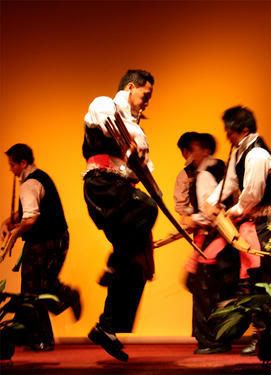
My interest in fabric arts made the embroidery one of the most interesting Hmong traditions to me. Girls each embroider a beautifully decorated skirt for ceremonial dances. We were welcomed into the village by two chanting women wearing these skirts and their matching embroidered jackets with silver necklaces and crowns, carrying bowls of baiju for us. We were also serenaded at a feast for us by women singing and dancing, and men playing the lu sheng, a multi-piped wind instrument that reminded me a lot of bagpipes. I had a chance to use the brightly colored silk thread to embroider a dragon on a piece of cloth. I'm not sure what it was for, but the pattern was beautiful.

I fear that this rich culture will fade over the next couple of generations. Tourism is becoming a bigger and bigger industry, and with tourism comes money and modern amenities. On one side, it will make the lives of these hard-working people easier. On the other, with an easier lifestyle comes a loss of culture and tradition because it will no longer be necessary, and introducing people of different traditions will water down their own traditions. I am curious to see how much this village will change in the coming years.

Read more...

Hmong Family and Clan

Wednesday, August 6, 2008

Hmong are group oriented. Hmong society is built on thousands of years of war, resistance to oppression, and dislocation. In these circumstances, the survival of the individual depends on the survival of the group. As a result, the interests of the group come before the interests of the individual. A Hmong person belongs to a family, the family belongs to a clan, and the clan belongs to the Hmong people. Hmong often use the term we to refer to their family, their clan, and their identity as a people. It is very common for a Hmong person to say peb tsev neeg (‘our family’), peb lub xeem (‘our clan’), and peb Hmoob (‘our Hmong people’).

The family is the basic social unit in traditional Hmong society. It serves as the unit of production, consumption, socialization, social control, and mutual assistance. While a Hmong household may vary in size from a married couple to more than 20 people, a typical household consists of an extended family made up of many generations.

There are about 19 Hmong clans in Laos: Cha or Chang, Cheng, Chu, Fang, Hang, Her, Khang, Kong, Kue, Lor or Lo, Lee or Ly, Moua, Phang, Tang, Thao, Vang, Vue, Xiong, and Yang. Within the clans, there might be several subclans, whose members can trace their ancestors to a common person or share a common tradition of ancestral worship and other ritual practices. Clan membership is obtained by birth, marriage for women, and adoption. Although a married Hmong woman continues to identify herself by her birth family’s clan name, for all practical purposes she is a member of her husband’s family and clan.

Members of a clan consider each other clan brothers or clan sisters. Socially and culturally, they are obligated to help each other. When two Hmong meet each other, they greet each other by saying Koj tuaj los! (‘You come!’). When someone passes through a Hmong village, a villager usually greets the passerby and insists that the passerby stop by his or her home for a meal or at least a cup of water. After greeting, they exchange names, ages, clans, and generations to establish their relationship in order to properly address each other. If they belong to the same clan, they will establish the precise relationship within the clan. If not, they will establish their relationship through the marriage of their kin, beginning with their wives and aunts. They will address one another using kinship terms, such as brother, uncle, aunt, and so on. In the highlands of Laos, every Hmong is related, either through close or distant relatives.

Source

Read more...

Zong Khang Yang Raises Awareness About Plight of Hmong People in Thailand and Laos

Tuesday, August 5, 2008

The image “http://www.hmongtimes.com/SiteImages/Article/1247a.jpg The image “http://www.hmongtimes.com/SiteImages/Article/1247b.jpg


Zong Khang Yang has a personal mission--but he doesn't feel like it should be a personal mission. Since discovering the plight and persecution of Hmong people left behind in the jungles of Laos and Thailand; the conditions his "family members and people" are living under have been the focus of his activities.


On June 16, 2004 he lead a group of 13 young people on what was dubbed, "The Long Walk For Freedom," from the State Capital in St. Paul to Washington D.C. The group made several stops along the way and worked to educate anyone and everyone they met along the way about the conditions and human rights abuses that the Hmong surviving in Laos have endured


Most recently his work has shifted to raise awareness about Hmong people in Thailand. With most of the refugee camps now closed, many Hmong find themselves at odds with the Thai government. The Thai government has kept no secret about the plans to return the Hmong to Laos. Several NGOs such as Doctors Without Borders/ Medicins Sans Frontieres have been working within Thailand to try and prevent this from happening.


On June 22 they failed in their efforts. 800 Hmong people were rounded up by Thai police and military and forced to return to Laos. Some reports say that the people were also badly beaten. There have been little to no reports about what happened to them after they were returned to Laos.


To raise awareness about their situation Zong Khang Yang built a large wooden cross and carried it along University Ave. from the State Capital to Norm Coleman's office. Yang said, " I was very concerned [when I heard of what happened in Thailand], some of our senators are also concerned, but that's our congress, our leaders. Are we going to sit and do nothing?"


Khang wore a traditional long jacket, "to symbolize my culture," and carried the wooden cross, "to symbolize suffering." Across the cross was written the words, "Please save my people in jungles Laos, Thailand Now!" Khang said, "I have no choice but to prick my own finger and write the words in my blood."


Fong Yang accompanied him carrying a Minnesota flag and Tyvone Lee carrying a United States Flag.


Khang stopped at Betty McCollum's office and several other offices on his journey, but he especially wanted to "encourage Hmong community to do their job"-call their family members to raise awareness and request that they call their representatives and senators and say:


1. Stop the Thai government from arresting Hmong and using force.


2. Allow an international peace commission to go into Laos and Thailand.


3. Follow-up on the 800 people returned to Laos. Say, "I am concerned about shelters, safety, medical attention. They have no place to live and possibly face execution. I am wondering if the Lao government will accept them."


Khang brought these requests to several local senators and representatives. Now he hopes to spread the word across the nation.


Source

Read more...

Minneapolis police: A mistake, an apology and then medals

Sunday, August 3, 2008

David Joles, Star Tribune

Vang Khang traded gunfire with Minneapolis police in December when
they raided his house looking for a violent gang member. Khang’s
family counted 22 bullet holes


By RODRIGO ZAMITH, Star Tribune

Last update: July 30, 2008 - 5:27 AM

First, the city apologized. Then it gave awards.


Eight Minneapolis officers received medals in City Hall Monday for
their valor in a botched raid that the city apologized for last year. That
isn't sitting well with the family shot at multiple times by the officers.

"I'm shocked that they're receiving awards for that night," said Yee
Moua. "My family is a mess right now. My [9-year-old] son, who saw
the shooting, still has nightmares and has needed therapy. They've
ruined a life, and I don't understand why they would get rewarded for
that."

The awards stemmed from a high-risk search in December. The eight
officers -- who had SWAT training -- entered the house expecting to
find a violent gang member. Instead, they found Vang Khang, a
35-year-old homeowner who thought he was being robbed. Khang shot
through his bedroom door at the officers until he understood who they
were.


In the midst of the shootout were Moua, who is Khang's wife, and their
six children, who range in age from 3 to 15. Moua said her family has
since abandoned the house and can no longer afford to keep it.

Minneapolis police spokesman Sgt. William Palmer said Tuesday the
department has acknowledged the raid was a mistake and has
apologized to the family. But he said the officers "performed very
bravely under gunfire and made smart decisions."

Minneapolis Police Chief Tim Dolan said that he knew giving the award
might get negative attention but that "we've never not recognized an
officer shot in the line of duty."

Three officers received shrapnel damage to body armor and their
ballistic helmets, Palmer said.

Dolan said he did not speak with the family prior to the award
ceremony, but he did speak with Hmong community leaders in north
Minneapolis who were "mostly understanding."

"I can understand [Moua's] feelings, but the officers didn't make any
mistakes and they were able to stop things from getting worse," Dolan
said. "Like the old maxim says, 'You don't punish your officers for the
mistake of the general.'"

'We almost died that night'


Police said they acted on bad information from an informant, who
reportedly was a victim of a crime at a house in the 1300 block of
Logan Avenue N. Police said they had no reason to believe the
information was inaccurate and they had the right address on the
warrant, but the house wasn't occupied by anybody they wanted.

The raid was part of an investigation by the department's Violent
Offender Task Force, which typically goes after the most violent gang
members and drug dealers. Officers had retrieved guns in searches
connected with the case before the raid.

According to police, officers entered the home without knocking -- a
standard procedure in cases where officers expected to find weapons --
and called out, "Police!" as they searched the home's first floor. They
didn't find anybody, so went to the second floor. At a small landing at
the top of the stairs, they again shouted, "Police!"


Shots then came through the walls and doors as officers searched two
bedrooms, police said. It was Khang shooting from a third bedroom.

Authorities said there were children in the other bedrooms, and the
officers quickly realized there was a language barrier. The older
children were able to communicate to their father that police were in
the house and to stop shooting.

"As soon as they started taking fire, [officers] got in front of the kids
and used their body as a shield," Palmer said. "They used great
restraint and shot precisely at where the bullets were coming back
from."

Moua disputed the police account.

"They never identified themselves; we thought they were a whole
bunch of drunk, crazy guys," she said. "We didn't know anything until
my oldest son yelled, 'Dad, it's the police!'"


She also said the officers did not try to protect her children, but rather
hid themselves behind furniture and shot back indiscriminately. She
said officers treated her and her husband roughly, and did not explain
the situation after the two surrendered.

"They stepped on my husband, and we kept asking, 'Where are the bad
guys?'" she said. "We were just trying to protect ours kids. We almost
died that night."

Lawsuit against the city

Sgt. Jesse Garcia said the city conducted an internal affairs
investigation after the raid and the SWAT team was cleared of any
wrongdoing. He said no other details were available because the
investigation was still open.


Casper Hill, a spokesman for the city of Minneapolis, said the city has
reimbursed the Khang family $7,500 for "miscellaneous expenses."


The family's lawyer, Thomas Heffelfinger, said that he has had ongoing
conversations with the city attorney's office and that there will be a
lawsuit if they cannot reach a resolution.

"They fired 22 rounds with 9 millimeter automatic weapons into a
room with two adults and four children," Heffelfinger said. "That's not
protecting kids. They were firing at a room they couldn't see into. They
fired with the intent to kill the person on the other side of the door.

"To give these men awards for that behavior is nothing more than an
attempt to sanitize their conduct."


Heffelfinger also said the family had lived at the house for four years
and had no history of wrongdoing. He said police "failed to do their
homework" and "acted outrageously once they got there."


Officers receiving medals of commendation included Sgt. Nicholas
Torborg and officers Steven Blackwell, Matthew Kaminski, Ricardo
Muro and Craig Taylor. Sgt. Michael Young and officers John
Sheneman and Alan Williams received medals of valor.

"We knew there might be political implications with this," Palmer said.
"We're not passing judgment today on the rest of what happened there.
But those officers were shot in the line of duty, and there isn't an
appropriate level of award for that."

Staff writer Abby Simons contributed to this report. Rodrigo Zamith •
612-673-4895


Tsi Meng, 6, was one of six children in the house during the shootout.

Officer receives medal.

Monday's award ceremony

Source

Read more...

Fresh Traditions: Center for Hmong Art and Talent fashion show

Friday, August 1, 2008

http://img.photobucket.com/albums/v153/nickiher/11.jpg


First of all, I want to give a big shout out to my girl Stephanie Ta Yang Xiong for doing some of the hair for the fashion show. Go girl! Did you know she graduated beauty school and is ceritified now?
Yes, Fashion Show was in Minnesota.


http://img.photobucket.com/albums/v153/nickiher/10.jpg

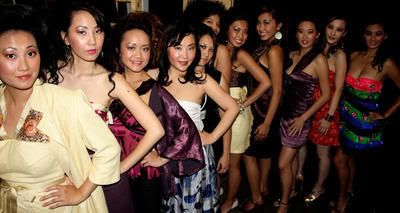
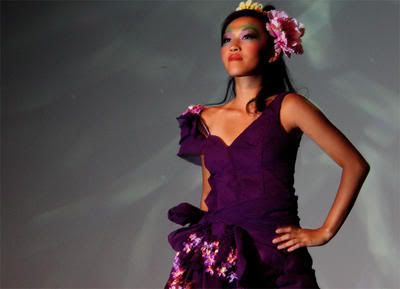
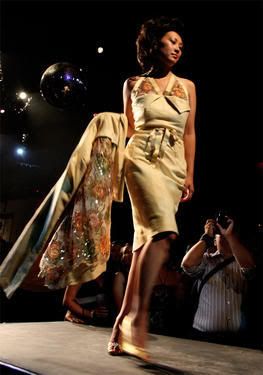
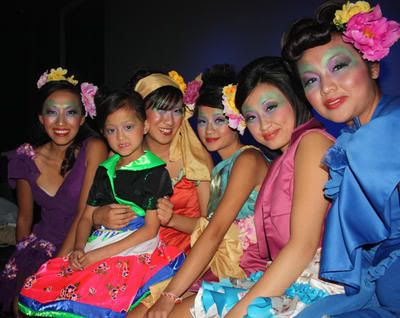
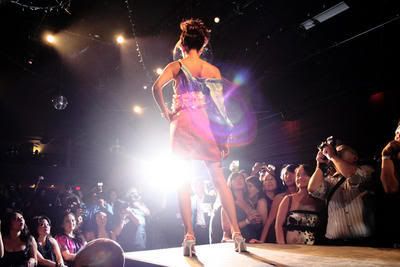
Five design lines premiered on the runway at the Varsity Theater Saturday night, July 26. Fresh Traditions II Fashion Show was presented by the Center for Hmong Art and Talent (CHAT), whose organizational mission is to nurture and develop Hmong artists to enhance the community. Fusing new, contemporary designs with the old, CHAT and the designers recognize the importance of the history of Hmong art, which is deeply rooted and woven into the textiles and fabrics of the clothing.

http://img.photobucket.com/albums/v153/nickiher/06.jpg


http://img.photobucket.com/albums/v153/nickiher/08.jpg

http://img.photobucket.com/albums/v153/nickiher/02.jpg


http://img.photobucket.com/albums/v153/nickiher/04.jpg


http://img.photobucket.com/albums/v153/nickiher/01-2.jpg


For more pics, go to the photographer website

Read more...